Most wear plate fails early for one reason: it was picked for one kind of wear and installed where a different kind is doing the damage. A plate that would have lasted two seasons in a chute floor cracks in a month under a truck loading zone, and the site blames the plate. The plate was fine. The match was wrong.
The two kinds of wear that decide your plate
Sliding abrasion is material moving across a surface under load and cutting it away a little at a time. Think of ore running down a chute, along a bucket floor or across a truck bed. It is steady, it is the main wear mode on most liners, and it is the one most people picture when they say wear plate.
Impact is material striking the surface. A big rock dropping into a box hits one spot hard, and the next load tends to hit the same spot again. Impact does not grind a plate away. It dents it, chips it or cracks it, and a plate that handles sliding well can be the wrong plate for that spot.
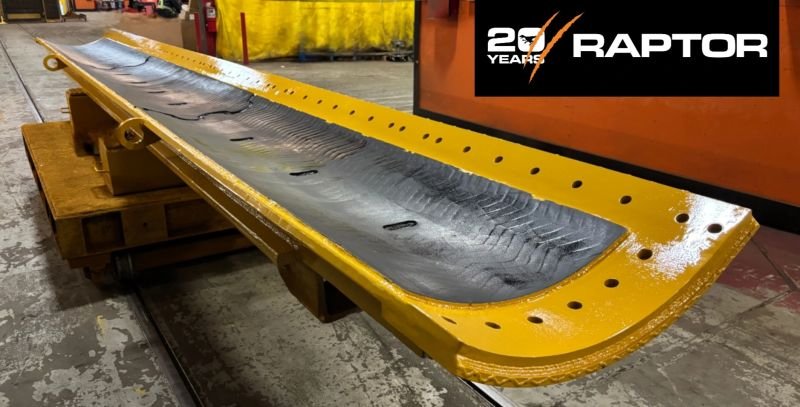
Chromium carbide overlay plate: built for sliding abrasion
Chromium carbide overlay (CCO) plate is a mild steel backing with a hard carbide layer welded on top. The carbide surface is what meets the abrasive material, so it is the plate to reach for where material grinds across the surface. Chute floors, hopper liners, bucket floors and the sliding faces of truck bodies are the usual homes for it.
Raptor makes its own: RaptorPlate® CCO plate, stocked in Canada, sold whole or cut to order, in a range of thicknesses. If you want to see how a CCO liner behaves over years of real work, the Yukon case study is a good place to start.
AR steel plate: built for impact
Abrasion resistant (AR) steel is a quench and tempered plate where the hardness runs through the thickness instead of sitting on the surface. That through-hardness is why it takes repeated hits better than an overlay plate. It gives up a little abrasion life next to carbide, and in exchange it does not crack where a rock lands.
Raptor supplies it as HarderPlate® in 400 BHN and 500 BHN grades. The lower grade gives up some hardness for toughness, which suits impact zones. The higher grade is harder, which suits zones where abrasion is the bigger problem. Tell us how the part fails today and we will recommend the grade.
AR plate vs chromium carbide overlay at a glance
| Chromium carbide overlay (RaptorPlate®) | AR steel plate (HarderPlate®) | |
|---|---|---|
| Best against | Sliding abrasion | Impact and repeated hits |
| Typical zones | Chute and hopper floors, bucket floors, sliding faces | Landing zones, dipper liners, blade edges, truck body impact areas |
| How it is made | Carbide layer over a mild steel backing | Quench and tempered, hardened through the plate |
| Where it gives ground | Cracks and chips under heavy impact | Wears faster than carbide under pure sliding |
| Grades | Range of thicknesses, whole or cut to order | 400 BHN and 500 BHN |
Most machines need both plates
A dozer blade, a loader bucket or a dipper sees sliding wear in some zones and impact in others. Putting one plate everywhere works, but you give up wear life in every zone where it is the wrong match. A mixed kit puts the overlay where material grinds and the hardened plate where material lands, so neither one is over-engineered for the job.
That is how our dozer blade wear kits are laid out, and it is the only gear we have that lets us GSD® the way the machine actually wears. Liners are welded in place, and our installation procedure covers how.
How to pick: three questions
First, look at the plate you are replacing and decide whether it was scoured or smashed. Second, note where on the machine the damage sits, because the same bucket can need both plates. Third, tell us what you move, because ore, rock and wet material wear plate in different ways.
Send a photo of the worn area if you have one. A photo of the old plate tells us more than a spec sheet, and it takes a minute. Lining a truck body or chute? See our guide to truck body and chute liners for a zone-by-zone layout.
Wear plate questions we hear most
PEOPLE. SAFETY. QUALITY. VELOCITY.