Installing wear plate right the first time is cheaper than doing it twice. Wear resistant CCO RaptorPlate® is a mild steel backing plate with a chrome carbide overlay, and it goes onto your equipment with welds. How you weld it decides whether the liner lasts or cracks.
This is Raptor's installation procedure for fillet welding and plug welding, with the weld parameters, the power supply we recommend and the one mistake that cracks welds. Have your site's welding procedure and a qualified welder on the job, and follow your own safety rules at every step.
What do I need to do before welding?
Start with the surface. The application area has to be clean and free of grease, rust and moisture. If the surface is painted, grind it back to clean metal.
It sounds basic, and it matters. A crew that preps properly gets to GSD® the first time and moves on, instead of coming back to the same liner on the next shutdown.
How is RaptorPlate® attached?
The mild steel backing plate is what you weld, so every sheet can be attached in more than one way.
Fillet weld. The backing plate is welded directly to your equipment around its edges.
Plug weld. Holes in the plate or in the equipment are filled with weld to hold the plate down.
Plate can also be supplied with studs welded to the mild steel side (M12, M16, M20 or M24) when the job calls for a different approach. Tell us how your equipment is set up and we will recommend the right method.
How do I weld RaptorPlate®?
What are the weld parameters?
Raptor's procedure uses an E7018 (E48018) electrode as the preferred choice, or whatever your base metal requires. The processes are GMAW, FCAW or SAW. Welding position can be any position.
Fillet weld size depends on the plate. For 4/5 mm plate, use a 3 mm fillet weld. For 6/6 mm plate, use a 4 mm fillet weld. For 10/10 mm plate, use a 6 mm fillet weld.
The procedure does not call for preheat, interpass or postheat on the plate itself. Your base metal may still have its own requirements, so check them before you strike an arc.
What power supply do I need?
For SMAW, a minimum 200 A power supply is recommended. For GMAW, use a minimum 250 A, 100% duty cycle, constant voltage power supply.
What are the steps?
First, tack the wear plate in place. Then run the weld, keeping the gap described below. Then place a full perimeter fillet weld around the entire plate as needed.
An optional pass of chrome carbide overlay can be placed over the attachment welds.
What is the one thing that cracks a RaptorPlate® weld?
Do not let the weld pool touch the chrome carbide.
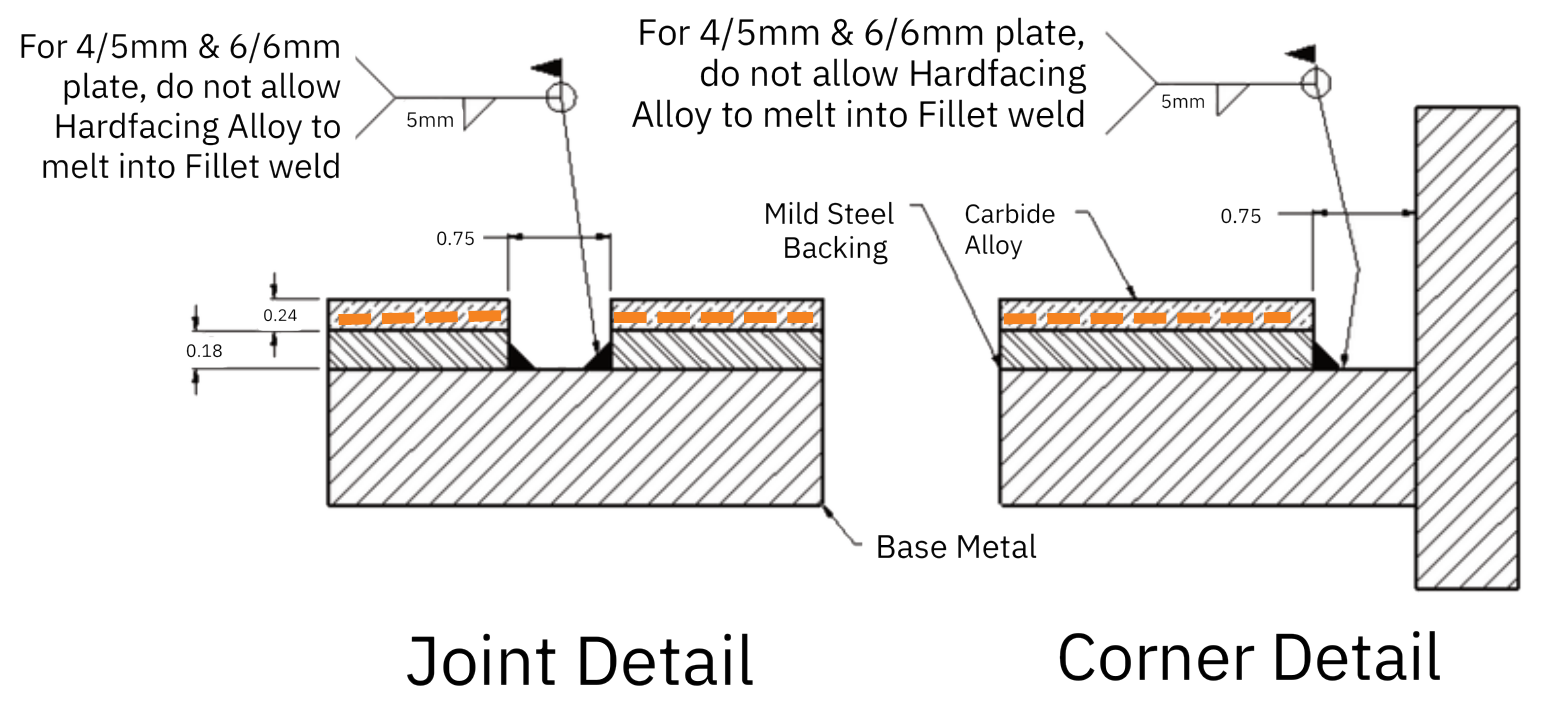
Keep roughly a 1/8 inch gap between the weld pool and the chrome carbide overlay. If the pool contacts the hardfacing, the weld picks up carbon from the alloy, and that carbon pickup is what leads to weld cracking later.
For 4/5 mm and 6/6 mm plate, do not let the hardfacing alloy melt into the fillet weld either. The drawings below show where the weld goes on a joint and on a corner.
How do I plug weld RaptorPlate®?
Plug welding uses the same electrode, the same processes and the same weld sizes as fillet welding: 3 mm for 4/5 mm plate, 4 mm for 6/6 mm plate and 6 mm for 10/10 mm plate. Preheat, interpass and postheat follow the same rules, and position can be any position.
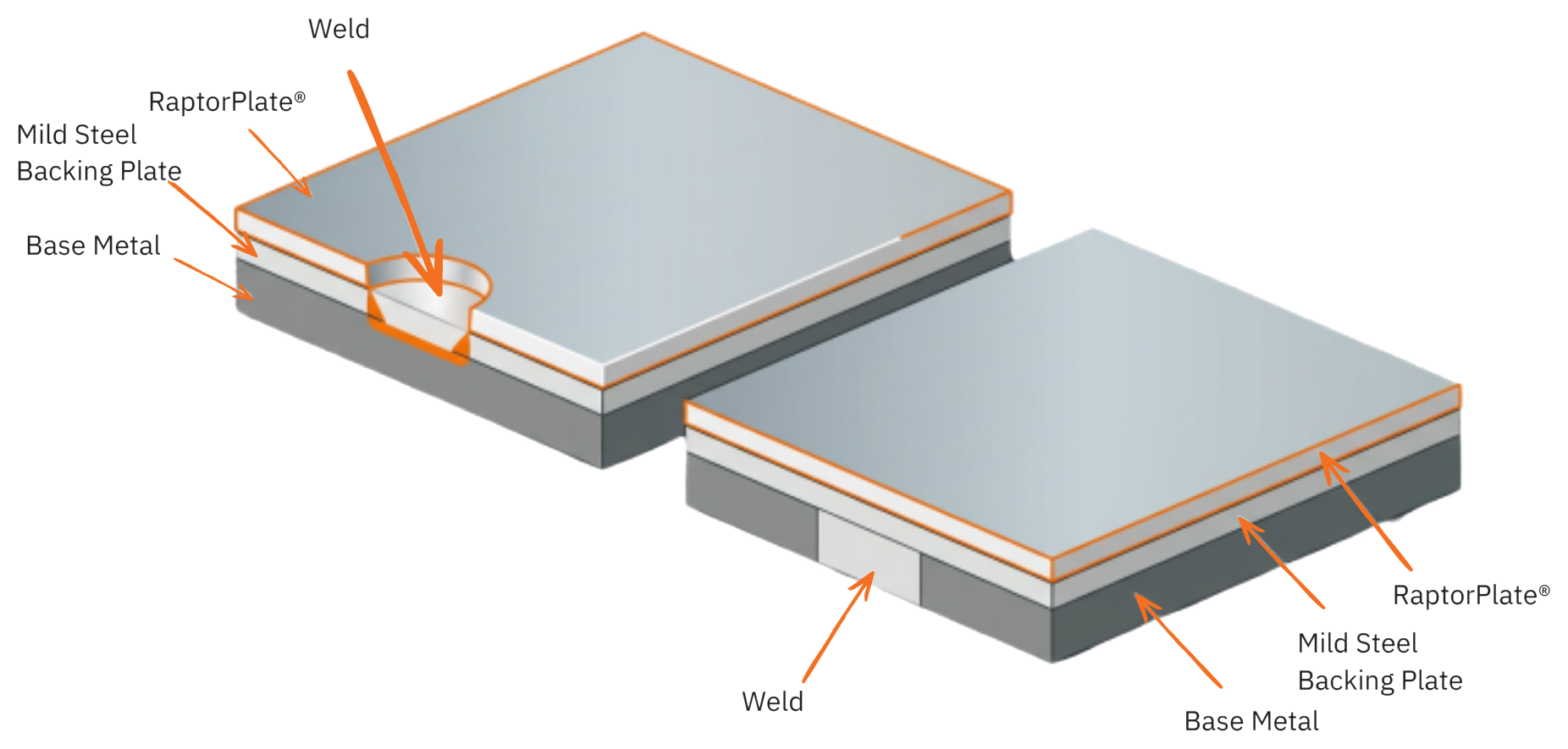
A hole can be placed either in the wear plate or in the equipment. The weld fills the hole and ties the plate to the base metal, as shown here.
Quick answers
Does RaptorPlate® need preheat? Raptor's procedure does not call for preheat, interpass or postheat on the plate. Follow any requirements your base metal has.
What electrode should I use? E7018 (E48018) is preferred, or as required by your base metal.
Which welding processes work? GMAW, FCAW and SAW, in any position.
How big should the fillet weld be? 3 mm for 4/5 mm plate, 4 mm for 6/6 mm plate and 6 mm for 10/10 mm plate.
Why does the weld pool need a gap from the chrome carbide? Contact lets carbon from the alloy into the weld, which causes weld cracking.
Plan your next liner install with Raptor
Every site is different, and plate size, attachment method and layout all change the install. Send us the machine and what is wearing out, and a Raptor wear specialist will come back with a fix and a quote.
See wear resistant CCO RaptorPlate®
PEOPLE. SAFETY. QUALITY. VELOCITY.